

Bitumen is one of the most important binder materials used in modern construction, especially in roads, highways, airport pavements, bridge decks, roofing systems, basements, foundations, industrial pavements, waterproofing works and pavement recycling. It is the black, sticky and water-resistant material that helps bind aggregates together in asphalt pavement and protects many structures from moisture damage.
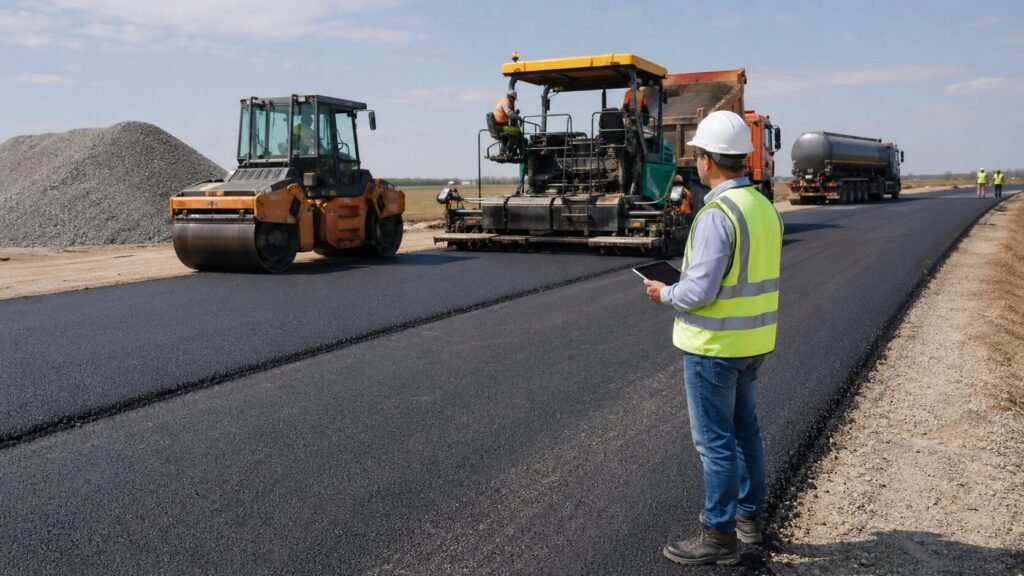
In simple words, bitumen works like a flexible glue in construction. It coats stone aggregates, binds them into a compacted asphalt layer, seals surface voids, resists water entry and allows pavement layers to tolerate small movements caused by traffic and temperature change. But in professional engineering, bitumen is not selected only because it is black, sticky or cheap. It is selected according to grade, penetration value, viscosity, temperature performance, traffic load, climate, ageing resistance, aggregate compatibility, application method and project specification.
A normal city road may use 60/70 penetration grade bitumen or VG-30 bitumen. A hot-climate highway may need VG-40, polymer modified bitumen or a high-temperature Performance Grade binder. A cold-region road may need a softer binder or a low-temperature PG binder. Road maintenance often uses bitumen emulsion, pavement recycling may use foamed bitumen, and roofing or basement waterproofing may use oxidized or polymer-modified bitumen membranes.
This page explains bitumen in construction in a practical, research-based and engineering-focused way so that students, engineers, contractors, buyers and site professionals can understand how bitumen is selected, tested, used and controlled on real projects.
What Is Bitumen?
Bitumen is a dark black or brown, highly viscous, adhesive and waterproof material mainly obtained from crude oil refining. It is the heavy residue left after lighter petroleum fractions are separated. In construction, bitumen is mainly used as a binder, sealant, waterproofing material and protective coating.
A practical definition is:
Bitumen is a petroleum-derived, thermoplastic and water-resistant construction binder used for asphalt paving, road surfacing, waterproofing, roofing, sealing and protective coating.
The word thermoplastic is important. It means bitumen softens when heated and hardens when cooled. This behavior makes it useful in road construction because it can be heated at the asphalt plant, mixed with aggregates, transported to site, laid by a paver and compacted by rollers. After cooling, it helps form a durable asphalt pavement layer.
Bitumen is used in construction for several important functions. In asphalt pavement, it coats and binds aggregates. In waterproofing, it creates a water-resistant barrier. In maintenance, it seals cracks, bonds pavement layers and protects old road surfaces. In industrial works, it can be used as a protective coating for underground structures, pipes and concrete surfaces.
The main point is simple: bitumen is not just a raw material; it is a performance-based construction binder. Its success depends on choosing the right type and grade for the right job.
Bitumen vs Asphalt vs Tar
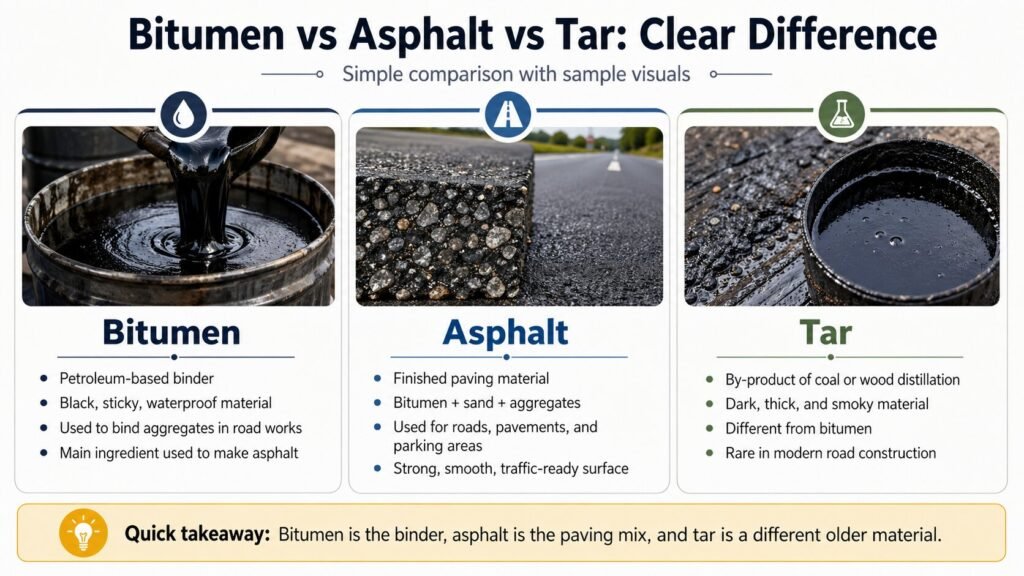
Many people use the words bitumen, asphalt and tar as if they mean the same thing. Technically, they are different.
| Term | Correct Meaning | Main Use | Example |
|---|---|---|---|
| Bitumen | Binder material | Binds aggregates and waterproofs surfaces | 60/70 bitumen, VG-30 bitumen |
| Asphalt | Mixture of aggregates, filler and bitumen binder | Road surface and pavement layers | Asphalt wearing course |
| Tar | Coal-derived or organic distillation material | Historical or limited road use | Old “tar road” terminology |
In many countries, bitumen means the binder and asphalt means the final road mixture. In North American terminology, the binder may also be called asphalt binder or asphalt cement.
A simple way to remember the difference is:
Bitumen is the binder. Asphalt is the road mix. Tar is a different historical material.
This difference matters on real construction projects. A buyer ordering bitumen is not ordering ready asphalt mix. A contractor laying asphalt is not laying pure bitumen. A project specification may separately define the binder grade, asphalt mix type, aggregate gradation, filler content, layer thickness, compaction requirement and quality control tests.
Why Bitumen Is Important in Construction
Bitumen is still widely used because construction projects need materials that can handle traffic load, moisture, heat, cold, ageing, vibration and movement. Roads face repeated wheel loads, braking force, rainwater, sunlight and temperature changes. Bridges face deck movement and water penetration. Airport pavements face heavy aircraft loads and high tire pressure. Roofs and basements need long-term water protection.
Bitumen performs well in these situations because it can bind, seal, flex and protect. It gives asphalt pavement its cohesion and waterproofing ability. It allows road surfaces to be repaired, overlaid, milled and recycled. It can also be modified with polymers, crumb rubber, rejuvenators and other additives when ordinary paving grade bitumen is not enough.
The quality of bitumen directly affects pavement life. If the binder is too soft for a hot and heavily loaded road, rutting and bleeding may occur. If the binder is too stiff for a cold region, thermal cracking can develop. If the bond between bitumen and aggregate is weak, water can cause stripping, ravelling and potholes.
This is why bitumen selection is an engineering decision, not a visual decision.
How Bitumen Works in Road and Construction Materials
Bitumen performance depends on several connected properties. A good binder must be workable during mixing and compaction, but stable during service. It must bond with aggregate, resist water, tolerate temperature changes and remain durable as it ages.
Adhesion with Aggregate
Adhesion is the bond between bitumen and aggregate. Good adhesion keeps the binder attached to stone particles even when water and traffic are present. Poor adhesion can lead to stripping, ravelling, loose aggregate and potholes.
Adhesion depends on aggregate type, surface cleanliness, dust, moisture, binder chemistry, temperature and anti-stripping additives. Wet or dusty aggregates are a common reason for poor coating and early pavement failure.
Cohesion inside the Binder
Cohesion is the internal strength of bitumen. It helps the binder resist tearing, deformation and aggregate loss. A binder with poor cohesion may not hold the asphalt mix together properly under traffic.
In hot climates, weak or overly soft binders can contribute to rutting. In cold climates, binders that become too stiff may contribute to cracking.
Viscosity and Workability
Viscosity means resistance to flow. During mixing, bitumen must be fluid enough to coat aggregates. During compaction, it must remain workable enough to help the asphalt achieve proper density. During service, it must be stiff enough to resist deformation.
This is why viscosity-controlled binders, such as VG grades, are important in hot mix asphalt work.
Temperature Sensitivity
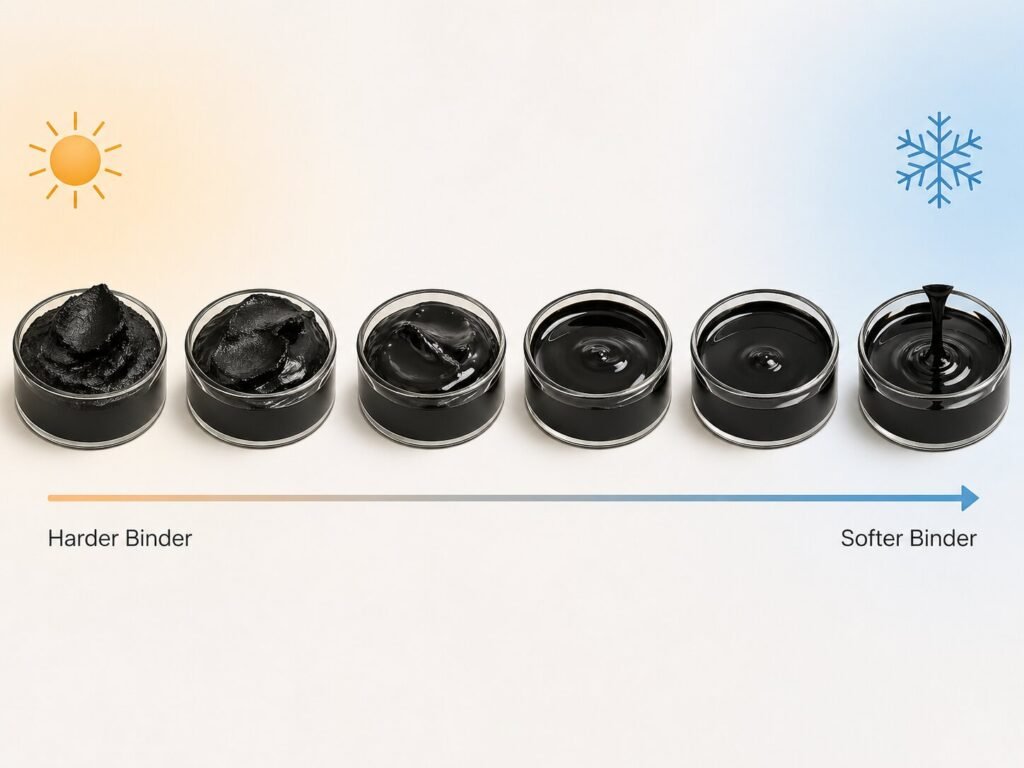
Bitumen becomes softer in heat and harder in cold. This is one of the biggest reasons grade selection matters.
| Project Condition | Binder Direction |
|---|---|
| Hot climate | Harder, higher-viscosity, modified or high-temperature PG binder |
| Cold climate | Softer or low-temperature PG binder |
| Heavy traffic | PMB, VG-40 or advanced PG binder |
| Road maintenance | Bitumen emulsion or approved maintenance binder |
| Recycling | Foamed bitumen or emulsion |
| Waterproofing | Oxidized or polymer-modified bitumen system |
A harder binder alone does not guarantee better performance. Rutting resistance also depends on aggregate skeleton, air voids, binder content, layer thickness, drainage and compaction quality.
Key Properties of Bitumen
A bitumen sample may look good but still fail if its properties do not match the project requirement. Engineers test bitumen to understand hardness, heat response, flow, flexibility, safety, ageing and rheological performance.
| Property | What It Means | Why It Matters |
|---|---|---|
| Penetration | Hardness or softness | Helps classify penetration grade |
| Softening Point | Temperature response | Indicates heat resistance and bleeding risk |
| Ductility | Stretching ability | Helps judge flexibility and cracking resistance |
| Viscosity | Flow resistance | Controls workability and deformation resistance |
| Flash Point | Safe heating behavior | Reduces fire risk during heating |
| Specific Gravity | Density | Used in quantity calculation and mix design |
| Solubility | Binder purity | Helps detect impurities or contamination |
| Water Content | Moisture in binder | Prevents foaming, splashing and safety hazards |
| Elastic Recovery | Recovery after stretching | Important for PMB and CRMB |
| Storage Stability | Modifier separation risk | Important for polymer and rubber modified binders |
| DSR Result | Shear and rheology behavior | Used in performance grade binder evaluation |
| BBR Result | Low-temperature stiffness | Helps predict thermal cracking risk |
| MSCR Result | Recovery under repeated stress | Useful for heavy traffic and modified binders |
A good project specification should not only say “use good quality bitumen.” It should clearly define the grade, test method, acceptance limits, sampling frequency, delivery temperature, storage requirement and rejection criteria.
Main Types and Grades of Bitumen Used in Construction
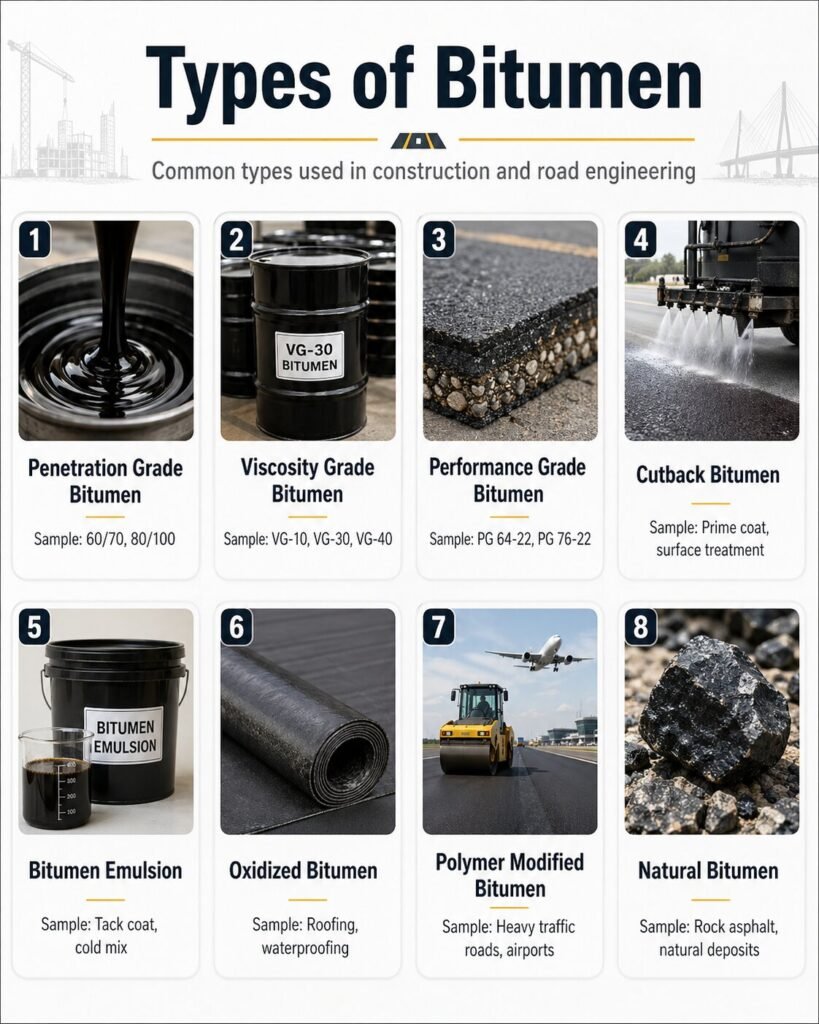
Bitumen is available in several types and grading systems. The correct choice depends on project use, climate, traffic, construction method and required performance.
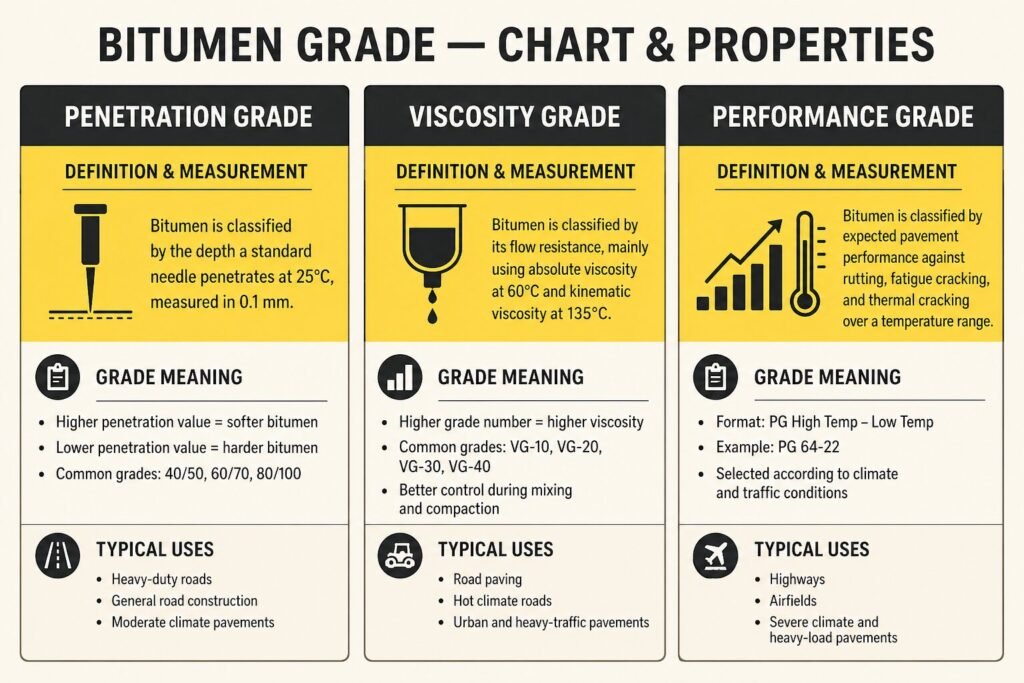
Penetration Grade Bitumen
Penetration grade bitumen is classified by the depth a standard needle penetrates into a bitumen sample under controlled temperature, load and time. The result is measured in tenths of a millimeter. Lower penetration value means harder bitumen. Higher penetration value means softer bitumen.
| Grade | General Character | Common Use |
|---|---|---|
| 30/40 | Very hard | Very hot climates and heavy-duty pavements |
| 40/50 | Hard | Hot climates and deformation-resistant roads |
| 50/70 | Medium-hard | Standard road works requiring moderate stiffness |
| 60/70 | Common paving grade | Moderate-to-hot climates and general road construction |
| 70/100 | Medium-soft | Moderate climates requiring balanced flexibility |
| 80/100 | Softer than 60/70 | Moderate or cooler climates and lighter traffic |
| 100/150 | Soft | Cold climates where flexibility is important |
| 160/220 | Very soft | Cold regions or special flexible applications |
| 200/300 | Extra soft | Very cold climates or selected sealing works |
Penetration grade is easy to understand and still widely used. However, penetration value alone does not fully predict rutting, fatigue cracking or low-temperature performance. For heavy traffic, extreme climate or high-value projects, viscosity grade, performance grade or modified binders may provide better control.
Viscosity Grade Bitumen
Viscosity Grade bitumen, commonly called VG bitumen, is classified by flow behavior. It gives better control of high-temperature performance than penetration grading alone.
| VG Grade | General Character | Common Use |
|---|---|---|
| VG-10 | Softer and more workable | Spraying, emulsion manufacturing and cooler climate work |
| VG-20 | Medium viscosity | Cooler climate roads and moderate traffic |
| VG-30 | Standard paving grade | Hot mix asphalt, binder course and wearing course |
| VG-40 | High viscosity and stiffness | Heavy traffic, hot climates, toll plazas, bus lanes and industrial pavements |
VG-30 is commonly used for general paving in many warm regions. VG-40 is selected where heavy traffic, slow-moving loads or high pavement temperatures increase rutting risk.
VG grading is strong for high-temperature flow control, but it does not fully solve every cold-climate issue. In extreme climates, performance grading can provide more temperature-specific selection.
Performance Grade Bitumen
Performance Grade bitumen, or PG binder, is a temperature-based grading system. It is commonly written as PG 58-22, PG 64-22, PG 70-10 or PG 76-22.
The first number represents high-temperature performance. The second number represents low-temperature performance. For example, PG 64-22 is designed for high pavement temperature performance around 64°C and low-temperature performance around -22°C.
AASHTO M 320 covers performance-graded asphalt binders, and its grading designations are related to maximum and minimum pavement design temperatures. (MATEST Russia)
| PG Binder | Typical Use |
|---|---|
| PG 52-28 | Colder regions with lower high-temperature stress |
| PG 58-22 | Moderate climate and moderate traffic |
| PG 64-22 | General-purpose performance binder |
| PG 70-10 | Hot regions with rutting risk |
| PG 76-22 | Heavy traffic, modified binder and high-stress pavement |
PG binder testing commonly uses DSR, BBR, RTFO, PAV and MSCR to evaluate rheology, ageing, low-temperature stiffness and repeated stress recovery. FHWA’s asphalt binder PG testing material also links PG binder verification with AASHTO M 320, R 29 and related test methods. (Federal Highway Administration)
Polymer Modified Bitumen
Polymer Modified Bitumen, or PMB, is bitumen improved with polymers to increase elasticity, rutting resistance, fatigue resistance and durability.
| PMB Type | Main Benefit |
|---|---|
| SBS Modified Bitumen | Improves elasticity, flexibility and fatigue resistance |
| EVA Modified Bitumen | Improves stiffness and deformation resistance |
| Elastomeric PMB | Better recovery after deformation |
| Plastomeric PMB | Better high-temperature stiffness |
PMB is commonly used in airports, bridges, expressways, intersections, bus lanes, toll plazas, heavy truck corridors and waterproofing membranes. It costs more than ordinary bitumen but can improve long-term performance where the pavement is under high stress.
Crumb Rubber Modified Bitumen
Crumb Rubber Modified Bitumen, or CRMB, uses processed waste tyre rubber to improve flexibility, elasticity and durability. It can support sustainable pavement construction by reusing waste tyres.
CRMB may be used in overlays, urban roads, flexible pavements, heavy-duty surface layers and sustainability-focused road projects. However, it requires proper blending, storage stability control, temperature management and quality testing. If handled poorly, rubber separation and inconsistent binder behavior may occur.
Bitumen Emulsion
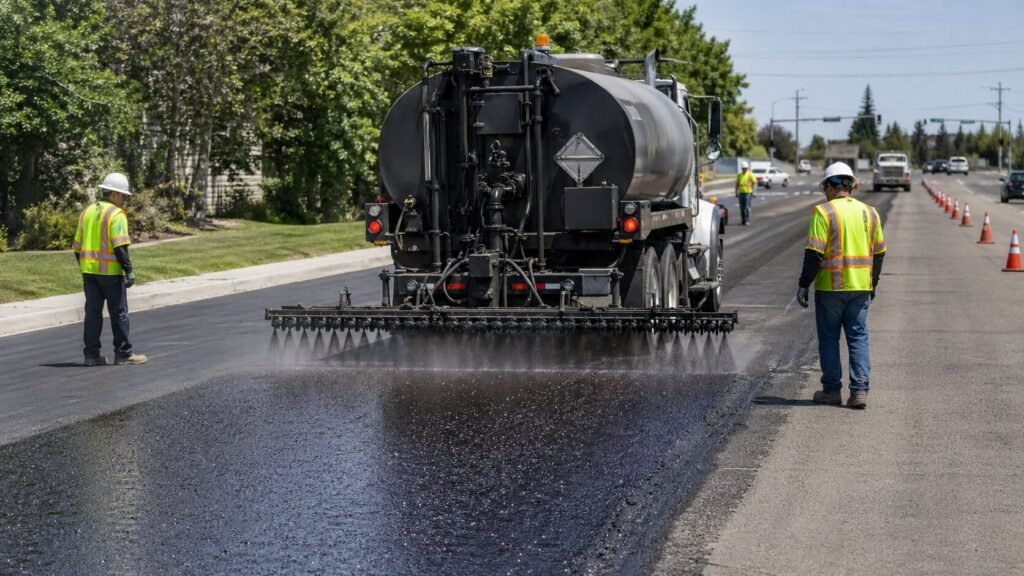
Bitumen emulsion is a mixture of bitumen, water and emulsifying agent. It allows bitumen to be applied at lower temperatures, which makes it useful for maintenance and surface treatment works.
| Emulsion Type | Meaning | Common Use |
|---|---|---|
| RS / CRS | Rapid Setting / Cationic Rapid Setting | Chip seal and surface dressing |
| MS / CMS | Medium Setting / Cationic Medium Setting | Open-graded mixes and patching |
| SS / CSS | Slow Setting / Cationic Slow Setting | Slurry seal, tack coat, prime coat and soil stabilization |
Bitumen emulsion is used for tack coat, prime coat, fog seal, slurry seal, microsurfacing, surface dressing, cold mix, pothole repair and soil stabilization. Its performance depends on weather, surface moisture, aggregate type, curing time and application rate.
Cutback Bitumen
Cutback bitumen is bitumen diluted with solvent to reduce viscosity. It can be used where lower-temperature application is needed, but it has environmental and safety concerns because the solvent evaporates during curing.
| Cutback Type | Meaning | Typical Use |
|---|---|---|
| RC | Rapid Curing | Quick-setting applications |
| MC | Medium Curing | Priming and selected maintenance |
| SC | Slow Curing | Longer curing applications |
Many modern projects prefer emulsions over cutbacks because cutbacks can release volatile organic compounds and create additional fire and health risks. Cutbacks should only be used where local specifications allow them.
Oxidized Bitumen
Oxidized bitumen, also called blown bitumen, is produced by blowing air through hot bitumen. This increases softening point and reduces flow at high temperatures.
| Oxidized Grade | Common Use |
|---|---|
| 85/25 | Roofing and waterproofing |
| 90/15 | Industrial coating and waterproofing |
| 115/15 | Heat-resistant waterproofing and industrial uses |
Oxidized bitumen is mainly used in roofing membranes, waterproofing sheets, damp-proofing, pipe coating, expansion joints, industrial insulation and protective coatings. It is generally not used as a normal paving binder.
Foamed Bitumen
Foamed bitumen is produced by injecting a small amount of water into hot bitumen. The water rapidly turns into steam and expands the bitumen temporarily into foam. This helps distribute bitumen in cold recycling and stabilization works.
Foamed bitumen is used in cold recycling, full-depth reclamation, base stabilization, pavement rehabilitation and reuse of existing pavement materials. Important parameters include expansion ratio, half-life, moisture content, binder content, aggregate gradation, mixing quality and compaction control.
Natural Bitumen and Specialty Additives
Natural bitumen, such as gilsonite-type materials, and specialty additives are used to improve stiffness, durability, waterproofing or high-temperature performance in selected applications. These materials require compatibility testing and controlled dosage because too much stiffness can create cracking risk.
Bitumen Selection Guide: Which Bitumen Should Be Used Where?
The right bitumen depends on climate, traffic, pavement layer, application method, moisture exposure and performance target. The table below gives a practical selection direction.
| Project Condition | Recommended Binder Direction | Why It Fits |
|---|---|---|
| Normal city roads | 60/70, 80/100 or VG-30 | Balanced paving performance |
| Hot climate highways | 40/50, 60/70, VG-40 or high PG binder | Better resistance to rutting |
| Cold climate roads | 80/100, 100/150, 160/220 or low-temperature PG binder | Better flexibility |
| Heavy traffic corridors | PMB, VG-40 or PG 76-22 | Resists deformation and fatigue |
| Toll plazas and intersections | PMB or VG-40 | Handles slow heavy loads and braking stress |
| Airport runways | PMB or PG binder | Handles aircraft loads and tire pressure |
| Bridge decks | Modified bitumen membrane | Resists water and deck movement |
| Road maintenance | RS/MS/SS emulsion | Lower-temperature application |
| Slurry seal and microsurfacing | SS/CSS emulsion | Controlled breaking and mixing |
| Cold recycling | Foamed bitumen or emulsion | Reuses existing pavement materials |
| Roofing | Oxidized or modified bitumen membrane | Heat-resistant waterproofing |
| Basement waterproofing | Modified bitumen membrane | Continuous water barrier |
| Industrial pavements | PMB, VG-40 or hard grade bitumen | Resists heavy static and slow-moving loads |
For hot and heavily loaded roads, the binder must resist permanent deformation. For cold regions, flexibility and low-temperature cracking resistance become more important. For wet areas, aggregate-binder adhesion and drainage are critical. For recycling work, the binder must be designed with existing aged material, not treated like a completely new mix.
Layer-Wise Use of Bitumen in Road Construction
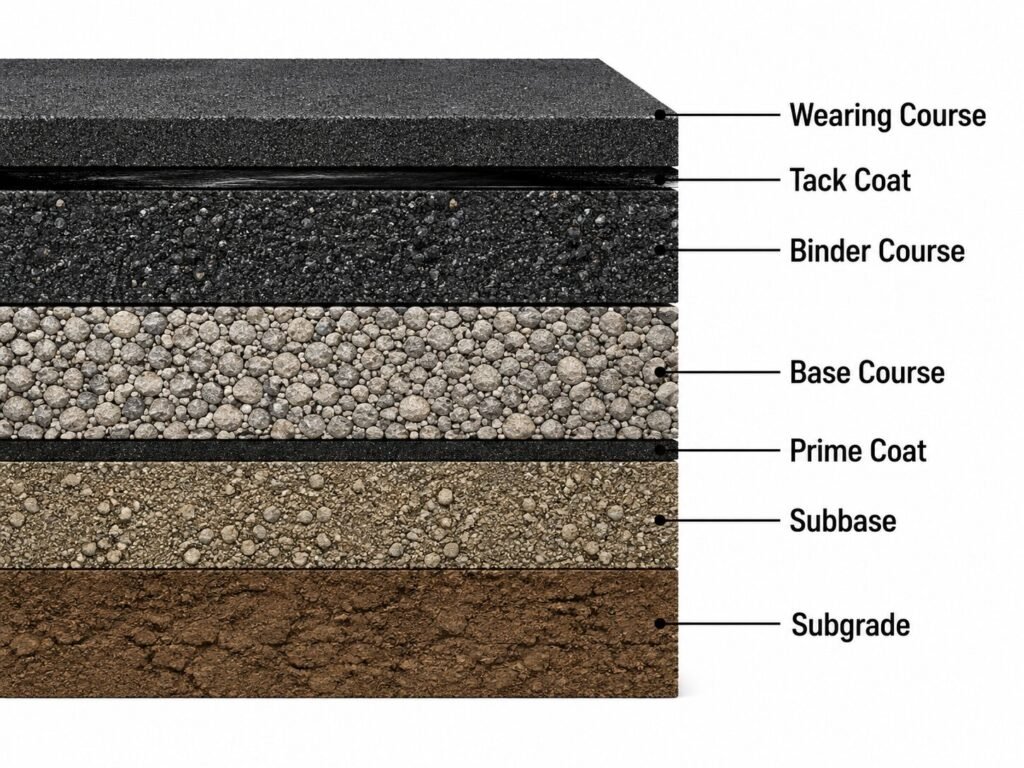
Bitumen is used in different pavement layers and road treatments. Each layer has a different function, so the same binder or application rate is not suitable everywhere.
| Layer or Treatment | Bitumen Role |
|---|---|
| Prime Coat | Penetrates granular base and prepares it for asphalt layer |
| Tack Coat | Bonds two asphalt or bituminous layers together |
| Binder Course | Provides structural support below the wearing course |
| Wearing Course | Provides smooth, durable and skid-resistant road surface |
| Seal Coat | Protects the surface from water and oxidation |
| Surface Dressing | Provides economical surface protection and texture |
| Slurry Seal | Restores surface texture and seals minor defects |
| Microsurfacing | Improves surface condition and fills shallow rutting |
| Overlay | Adds a new asphalt layer over existing pavement |
| Full-Depth Reclamation | Recycles existing pavement and base materials |
Layer bonding is especially important. Poor tack coat application can cause slippage, shoving, delamination and early pavement failure. A good pavement is not only about the top surface; it depends on how all layers work together.
Major Uses of Bitumen in Construction
Road Construction
Bitumen is mainly used in asphalt concrete, dense bituminous macadam, binder course, wearing course and base course. It coats aggregates and helps create a compacted pavement layer that can carry traffic.
Highways and Expressways
Highways need binders that can resist traffic stress, moisture, heat and ageing. Depending on climate and loading, highway projects may use VG-30, VG-40, PMB or PG binders.
Airport Pavements
Airport runways, taxiways and aprons require high-performance binders because aircraft loads, braking stress and tire pressure create severe pavement conditions. PMB and PG binders are often preferred where performance requirements are high.
Bridge Deck Waterproofing
Bridge decks need waterproofing systems that protect concrete and reinforcement from water and chlorides. Modified bitumen membranes are commonly used because they can tolerate movement and provide a continuous barrier.
Roofing and Waterproofing
Oxidized and modified bitumen are used in flat roofs, basements, retaining walls, podium decks, foundations and damp-proof courses. Proper surface preparation, overlap, protection board and drainage are essential for long-term waterproofing.
Industrial Pavements
Ports, container yards, truck terminals, warehouses and logistics parks need bituminous systems that resist slow-moving heavy loads and static pressure. VG-40, PMB or hard grade binders may be used depending on design.
Road Maintenance
Bitumen emulsions and special bituminous products are used for tack coat, prime coat, fog seal, slurry seal, microsurfacing, surface dressing, crack sealing and pothole repair.
Pavement Recycling and Rehabilitation
Foamed bitumen and emulsions are used in cold recycling, full-depth reclamation and base stabilization. FHWA supports the use of recycled highway materials where practical and economical, with the goal of reducing waste, preserving resources and maintaining or improving performance. (Federal Highway Administration)
Step-by-Step Use of Bitumen in Road Construction
Bitumen road construction is a controlled process. A weak step in design, heating, laying or compaction can reduce pavement life.
Step 1: Project Assessment
Engineers first study traffic level, climate, axle loads, subgrade condition, drainage, pavement life and service environment. This information guides binder selection and asphalt mix design.
Step 2: Binder Selection
The binder grade is selected according to project conditions. A normal road may use 60/70 or VG-30. A heavy-traffic or high-temperature road may require VG-40, PMB or a high PG binder.
Step 3: Aggregate Selection
Aggregates must be clean, strong, angular, durable and properly graded. Wet, dusty or weak aggregates can cause poor coating and early failure.
Step 4: Job Mix Formula
The job mix formula defines aggregate gradation, binder content, filler content, air voids, stability, flow, density and volumetric properties. It is the technical recipe for the asphalt mix.
Step 5: Heating and Mixing
Bitumen and aggregates are heated to the required temperature. Overheating can age the binder, while low temperature can reduce coating and compaction quality.
Step 6: Transportation
Hot mix asphalt is transported in clean and insulated trucks to minimize temperature loss and avoid contamination.
Step 7: Laying
A paver spreads the asphalt to the required thickness, slope, camber and level. Continuous paving helps reduce cold joints and weak points.
Step 8: Compaction
Rollers compact the asphalt while it is still hot enough. Proper compaction reduces air voids, improves durability and limits water entry.
Step 9: Quality Control
Quality control includes temperature checks, field density testing, thickness verification, binder content, gradation, smoothness, core samples and surface inspection.
A durable pavement needs correct binder, correct mix, correct temperature, correct compaction and proper drainage.
Bitumen Quality Testing
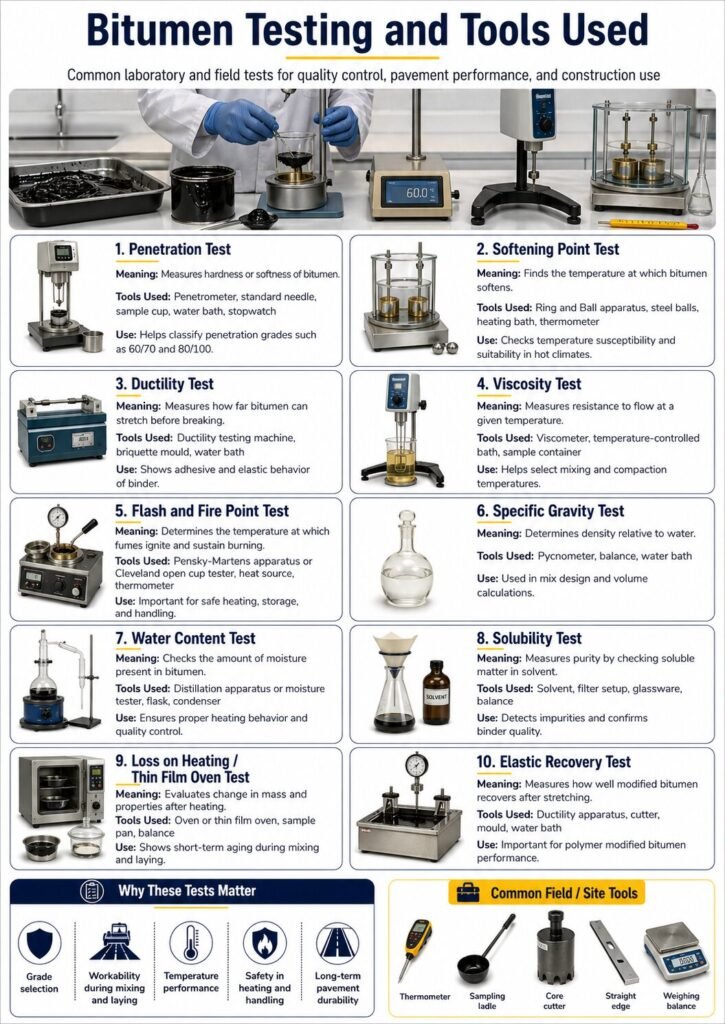
Bitumen is tested to confirm whether it meets the project specification. These tests help engineers understand hardness, flow, heat response, ageing, flexibility and performance.
| Test | What It Measures | Why It Matters |
|---|---|---|
| Penetration Test | Hardness or consistency | Classifies penetration grade |
| Softening Point Test | Heat response | Helps judge bleeding and rutting risk |
| Ductility Test | Stretching ability | Indicates flexibility |
| Viscosity Test | Flow resistance | Controls workability and deformation resistance |
| Flash Point Test | Safe heating limit | Reduces fire risk |
| Specific Gravity Test | Density | Used in quantity calculation and mix design |
| Solubility Test | Binder purity | Detects contamination |
| Water Content Test | Moisture in binder | Prevents foaming and splashing |
| RTFO Test | Short-term ageing | Simulates ageing during mixing and laying |
| PAV Test | Long-term ageing | Simulates service-life hardening |
| DSR Test | Rheological behavior | Evaluates rutting and fatigue-related behavior |
| BBR Test | Low-temperature stiffness | Predicts thermal cracking risk |
| MSCR Test | Repeated stress recovery | Useful for heavy traffic and modified binders |
| Elastic Recovery Test | Recovery after stretching | Important for PMB and CRMB |
| Storage Stability Test | Modifier separation | Confirms modified binder stability |
Common International Bitumen Test Standards
Different countries and clients may use ASTM, AASHTO, EN, BIS, Austroads or local highway authority standards. The project specification should clearly mention the required test method and acceptance limit.
| Property or Test | Common Standard References |
|---|---|
| Penetration | ASTM D5, AASHTO T49, EN 1426 |
| Softening Point | ASTM D36, EN 1427 |
| Ductility | ASTM D113 |
| Flash Point | ASTM D92 |
| Rotational Viscosity | ASTM D4402, AASHTO T316 |
| RTFO Ageing | ASTM D2872, AASHTO T240 |
| PAV Ageing | AASHTO R28 |
| DSR | AASHTO T315 |
| BBR | AASHTO T313 |
| MSCR | AASHTO T350 |
| Solubility | ASTM D2042 |
| Specific Gravity | ASTM D70 |
| Water Content | ASTM D95 |
The Asphalt Institute has also highlighted the rotational viscosity requirement in AASHTO M 320, including the original binder viscosity limit at 135°C, which is important for pumpability and handling of PG binders. (Asphalt Institute)
A strong specification should include:
- Binder grade
- Test standard
- Acceptance limits
- Sampling frequency
- Delivery temperature requirement
- Storage requirement
- Retesting procedure
- Rejection criteria
Asphalt Mix Quality and Strength Tests
Binder testing alone is not enough. A road performs as a complete asphalt mix, not as bitumen alone. Aggregate gradation, binder content, air voids, density and compaction quality all affect performance.
| Asphalt Mix Test | Measures | Why It Matters |
|---|---|---|
| Marshall Stability Test | Load resistance and flow | Evaluates mix strength |
| Superpave Gyratory Compaction | Mix densification and volumetrics | Designs mixes by traffic level |
| Indirect Tensile Strength | Tensile strength | Evaluates cracking resistance |
| Tensile Strength Ratio | Moisture susceptibility | Checks stripping risk |
| Wheel Tracking Test | Rutting under repeated load | Important for hot climates and heavy traffic |
| Hamburg Wheel Tracking Test | Rutting plus moisture damage | Strong durability indicator |
| Four-Point Bending Fatigue Test | Repeated bending resistance | Used for long-life pavement design |
| Dynamic Modulus Test | Stiffness at temperature and frequency | Used in advanced pavement design |
| Cantabro Loss Test | Abrasion and ravelling resistance | Useful for porous/open-graded mixes |
| Core Cutting and Field Density | Actual compaction and thickness | Confirms field quality |
| Falling Weight Deflectometer | Pavement structural response | Evaluates pavement strength |
| Skid Resistance Test | Surface friction | Important for road safety |
| IRI/Roughness Test | Ride quality | Measures smoothness and comfort |
Rutting and fatigue cracking are among the major distresses studied in asphalt pavement performance, and research consistently links pavement behavior to binder properties, aggregate gradation, additives, traffic and mixture design. (UM Research Repository)
Bitumen Acceptance Checklist Before Site Use
Bitumen should not be accepted simply because it arrived on site. It should be accepted only when it matches the project specification.
Document Checklist
Before unloading, site staff should verify supplier name, grade, batch number, certificate of analysis, production date, delivery date, tanker number, quantity, compliance certificate and Safety Data Sheet.
Site Inspection Checklist
The site team should check correct grade labeling, delivery temperature, tanker cleanliness, water contamination, foreign material, unloading safety and storage tank condition. Mixing unknown grades in the same tank should be avoided.
Laboratory Verification Checklist
Depending on project requirements, the laboratory may verify penetration, softening point, viscosity, flash point, water content, elastic recovery, storage stability, DSR, BBR or MSCR.
The site rule should be:
Do not accept bitumen by appearance. Accept it by specification, documentation and test results.
Common Bitumen and Asphalt Failures
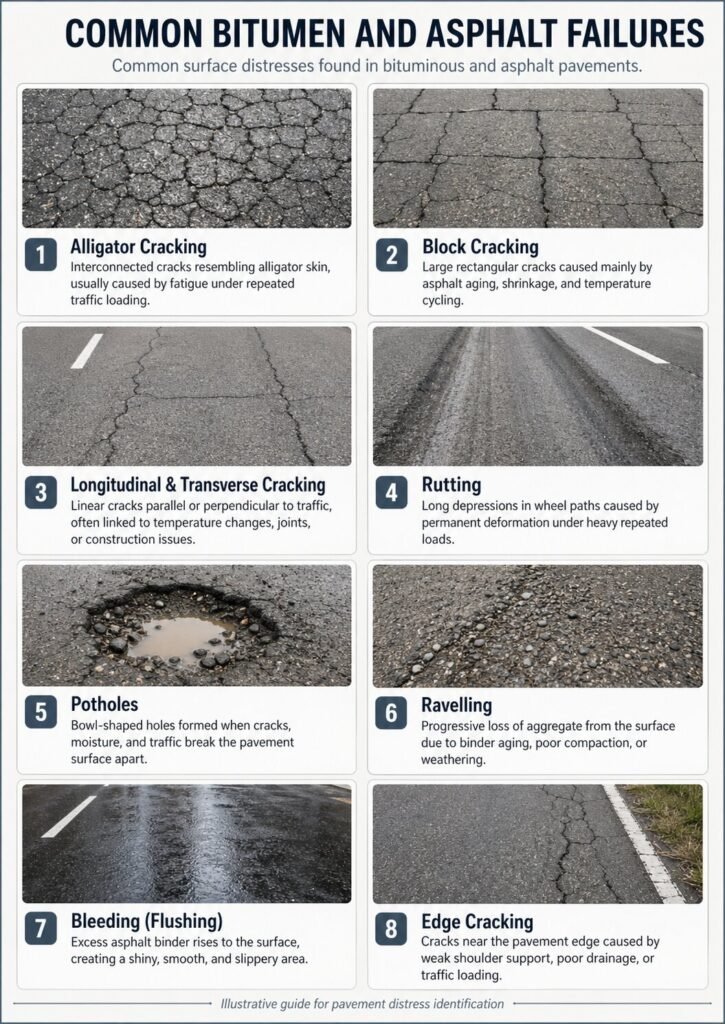
Most asphalt failures are not caused by one single issue. They usually result from a combination of wrong binder selection, weak mix design, poor drainage, bad compaction, overheating, water damage or delayed maintenance.
| Failure | Visible Sign | Main Cause | Prevention |
|---|---|---|---|
| Rutting | Wheel-path depressions | Soft binder, weak mix, heat, heavy loads | Use VG-40, PMB, high PG binder and strong aggregate skeleton |
| Bleeding | Shiny black surface | Excess binder, low air voids, high temperature | Correct binder content and mix design |
| Fatigue Cracking | Alligator cracks | Repeated loads, weak structure, aged binder | Proper thickness, drainage and durable mix |
| Thermal Cracking | Transverse cracks | Binder too stiff in cold | Use softer grade or low-temperature PG binder |
| Ravelling | Loose aggregate | Poor coating, low binder or poor compaction | Improve coating, binder content and density |
| Stripping | Binder loss from aggregate | Water damage and weak adhesion | Use dry aggregate, anti-stripping additive and TSR testing |
| Potholes | Broken pavement holes | Water entry, traffic and weak layers | Seal cracks, improve drainage and repair early |
| Shoving | Horizontal displacement | Braking stress, weak tack coat, unstable mix | Use proper tack coat and rut-resistant mix |
| Corrugation | Wavy surface | Unstable mix and repeated traffic stress | Improve mix stability and compaction |
| Age Hardening | Brittle surface and cracks | Oxidation, overheating and high air voids | Control temperature, compaction and air voids |
Using more bitumen is not always the solution. Excess binder can cause bleeding and rutting. A durable asphalt pavement needs balanced mix design, suitable binder grade, clean aggregate, controlled temperature and proper compaction.
Causes of Bitumen Failure and How to Prevent Them
Bitumen-related failures are often preventable when quality control starts before construction.
Common causes include wrong binder grade, poor aggregate quality, wet or dusty aggregates, excess binder, insufficient binder, poor drainage, overheating, low compaction temperature, weak tack coat, poor density, inadequate thickness, contamination and delayed maintenance.
Practical prevention includes using harder or modified binders in hot/heavy-traffic areas, softer binders in cold areas, PMB where rutting and fatigue risk is high, dry aggregates, accurate binder content, proper tack coat, correct compaction temperature, good drainage and timely crack sealing.
Good pavement performance begins before construction, not after failure appears.
Storage, Heating, Handling and Safety of Bitumen
Bitumen is often stored and handled hot, so temperature control and worker safety are essential.
Storage Rules
Use clean tanks, prevent water entry, avoid mixing unknown grades, maintain pumps and pipelines, keep sampling points accessible, monitor storage temperature and circulate modified binders when required.
Heating Rules
Heat bitumen only to the required working temperature. Avoid local overheating near heating coils. Do not allow water to enter hot bitumen because it can cause violent foaming and splashing. Follow supplier and project specification limits.
Safety Rules
Workers should use heat-resistant gloves, face shield, eye protection, safety boots and long sleeves. Fire extinguishers should be available near heating and unloading areas. No-smoking zones, proper ventilation, emergency training and Safety Data Sheets are important.
| Material | Handling Requirement |
|---|---|
| PMB | Controlled temperature and possible circulation |
| CRMB | Storage stability and agitation control |
| Emulsion | Avoid freezing, overheating and contamination |
| Cutback | Control fire risk and solvent exposure |
| Hot Bitumen | Keep away from water and open flames |
Good handling protects workers, equipment and pavement performance.
Sustainability and Modern Bitumen Technologies
Bitumen is petroleum-based, but asphalt construction can still support sustainability when designed properly. True sustainability means better life-cycle performance, lower waste, efficient material use and safe long-term service.
Reclaimed Asphalt Pavement
Reclaimed Asphalt Pavement, or RAP, uses old asphalt in new pavement. It reduces demand for virgin aggregate and fresh binder. FHWA promotes recycled highway materials where practical and economical, with the goal of reducing waste and preserving natural resources while maintaining performance. (Federal Highway Administration)
Warm Mix Asphalt
Warm Mix Asphalt allows asphalt to be produced and placed at lower temperatures than traditional hot mix asphalt. FHWA notes that the immediate benefit of WMA is reduced energy consumption from heating fuels at the plant. (Federal Highway Administration)
Rejuvenators
Rejuvenators help restore flexibility in aged binder from reclaimed asphalt. They are useful when higher recycled content is used, but dosage must be carefully designed and tested.
Rubberized Asphalt
Rubberized asphalt uses crumb rubber from waste tyres. It can improve flexibility and support waste reuse when properly processed and tested.
Polymer Modified Bitumen
PMB improves rutting resistance, fatigue resistance and durability, especially in heavy traffic and high-temperature pavements.
Bio-Based and Nano-Modified Binders
Bio-based additives and nano-additives are being studied for recycling support, ageing resistance, moisture resistance and durability. These technologies need proper laboratory and field validation before large-scale use.
Low-Carbon Asphalt Approach
A low-carbon asphalt strategy may combine warm mix technology, RAP, efficient plant operation, optimized binder content, local materials, preventive maintenance, long-life pavement design and life-cycle assessment.
A recycled road is not automatically sustainable if it fails early. The best sustainable bitumen project balances durability, recycling, safety, cost, performance and life-cycle impact.
How to Choose the Right Bitumen Supplier
A supplier should be selected by quality, consistency, documentation, logistics and technical support, not only by price.
A good supplier should provide consistent grade quality, complete test certificates, batch traceability, clean tankers, correct delivery temperature, reliable logistics, technical support, third-party testing options and proper packaging.
Important documents include certificate of analysis, batch number, grade confirmation, test report, delivery temperature record, Safety Data Sheet and compliance certificate.
Cheap bitumen can become expensive if it causes rejection, rutting, cracking, water damage or early maintenance.
Expert Comparison Table: Bitumen Types, Grades, Tests, Uses and Limitations
| Bitumen Type | Common Grades | Key Properties | Main Tests | Best Uses | Limitations |
|---|---|---|---|---|---|
| Penetration Grade | 40/50, 60/70, 80/100, 100/150 | Hardness and consistency | Penetration, softening point, ductility | Standard roads | Less performance-specific |
| Viscosity Grade | VG-10, VG-20, VG-30, VG-40 | Flow control and workability | Viscosity at 60°C/135°C | Hot mix asphalt | Must match climate and load |
| Performance Grade | PG 64-22, PG 70-10, PG 76-22 | Temperature-based performance | DSR, BBR, RTFO, PAV | Premium highways and airports | Advanced testing required |
| PMB | SBS, EVA, elastomeric | Elasticity and durability | Elastic recovery, MSCR | Airports, bridges, expressways | Higher cost |
| CRMB | Rubber modified | Flexibility and sustainability | Viscosity, storage stability | Overlays and urban roads | Storage control needed |
| Emulsion | RS, MS, SS, CRS, CMS, CSS | Lower-temperature application | Residue, setting time, sieve test | Maintenance | Weather sensitive |
| Cutback | RC, MC, SC | Solvent-reduced viscosity | Viscosity, curing behavior | Limited priming applications | Environmental and fire concerns |
| Oxidized Bitumen | 85/25, 90/15, 115/15 | High softening point | Penetration, softening point | Roofing and waterproofing | Not normal paving binder |
| Foamed Bitumen | Project-designed | Temporary expansion | Expansion ratio, half-life | Recycling and stabilization | Special equipment needed |
| Natural Bitumen | Gilsonite-type | Stiffness and durability | Compatibility tests | Specialty asphalt | Dosage control required |
Common Mistakes in Bitumen Construction
Many bitumen failures happen because of simple mistakes that could have been avoided. The most common mistakes are selecting binder only by price, using one grade for every climate, ignoring traffic loading, using wet aggregates, overheating bitumen, applying poor tack coat, using incorrect binder content, accepting poor field compaction, ignoring air voids, using emulsion without curing time, mixing different grades in one tank, skipping lab verification and delaying crack sealing.
A professional project should control bitumen from procurement to placement. Quality should not begin at the road surface; it should begin at specification, supplier selection and material testing.
FAQs About Bitumen in Construction
What is bitumen used for in construction?
Bitumen is used for road paving, asphalt production, waterproofing, roofing, bridge deck protection, basement coating, foundation protection, industrial pavements, maintenance and pavement recycling.
Which bitumen is best for road construction?
For normal roads, 60/70, 80/100, VG-30 or VG-40 may be used depending on climate and traffic. For heavy traffic, PMB or PG binder may be more suitable.
What is the difference between 60/70 and 80/100 bitumen?
60/70 bitumen is harder and is generally used in moderate-to-hot climates and heavier traffic. 80/100 bitumen is softer and is more suitable for moderate or cooler climates and lighter traffic.
What is VG-30 bitumen used for?
VG-30 is widely used in hot mix asphalt for road construction, especially in moderate and hot climate conditions.
What is VG-40 bitumen used for?
VG-40 is used in heavy traffic and high-temperature areas such as intersections, toll booths, bus lanes, truck routes and industrial pavements.
What is Performance Grade bitumen?
Performance Grade bitumen is a temperature-based binder grading system. It classifies binders according to high and low pavement temperature performance.
What is PMB?
PMB means Polymer Modified Bitumen. It improves elasticity, rutting resistance, fatigue resistance and durability.
What is CRMB?
CRMB means Crumb Rubber Modified Bitumen. It uses processed waste tyre rubber to improve flexibility and support sustainable pavement construction.
What is bitumen emulsion?
Bitumen emulsion is bitumen dispersed in water with an emulsifier. It is used for tack coat, prime coat, slurry seal, microsurfacing, surface dressing and maintenance.
Is bitumen waterproof?
Yes, bitumen is water-resistant and widely used in waterproofing. Good surface preparation, correct application thickness, proper overlaps and protection layers are essential.
Can bitumen be recycled?
Yes, bitumen in asphalt pavement can be reused through reclaimed asphalt pavement, cold recycling and full-depth reclamation systems.
Why does asphalt pavement fail?
Asphalt pavement may fail due to wrong binder grade, weak mix design, poor compaction, water entry, poor drainage, overheating, ageing or heavy traffic stress.
Conclusion
Bitumen is not just a black sticky material. It is a performance-based construction binder used in roads, highways, airports, bridges, roofs, basements, industrial pavements, waterproofing systems and recycling works.
Its performance depends on selecting the correct type, grade, test method, application temperature, storage condition and construction process.
A normal road may use 60/70 or VG-30. A hot-climate highway may need VG-40 or a high-temperature PG binder. A cold-region road may need a softer penetration grade or low-temperature PG binder. A heavy-traffic corridor may require polymer modified bitumen. A maintenance project may need emulsion. A recycling project may need foamed bitumen. A roof or basement may need oxidized or modified waterproofing bitumen.
The most important rule is:
Use the right bitumen type, in the right grade, tested by the right method, for the right project condition.
Contact us
Need accurate civil engineering calculations for road materials, asphalt work, concrete quantities or construction cost planning? Use our professional civil engineering calculators to estimate material requirements before starting construction or contact us
References
- Federal Highway Administration, asphalt pavement recycling and reclaimed asphalt pavement resources. (Federal Highway Administration)
- Federal Highway Administration, Warm Mix Asphalt technologies and research. (Federal Highway Administration)
- AASHTO M 320, Performance-Graded Asphalt Binder specification summary. (MATEST Russia)
- FHWA asphalt binder PG testing manual and related AASHTO test references. (Federal Highway Administration)
- Asphalt Institute guidance on AASHTO M 320 rotational viscosity limits. (Asphalt Institute)
- Asphalt pavement performance literature on rutting, fatigue, binder behavior and aggregate structure. (TransResearch Library)