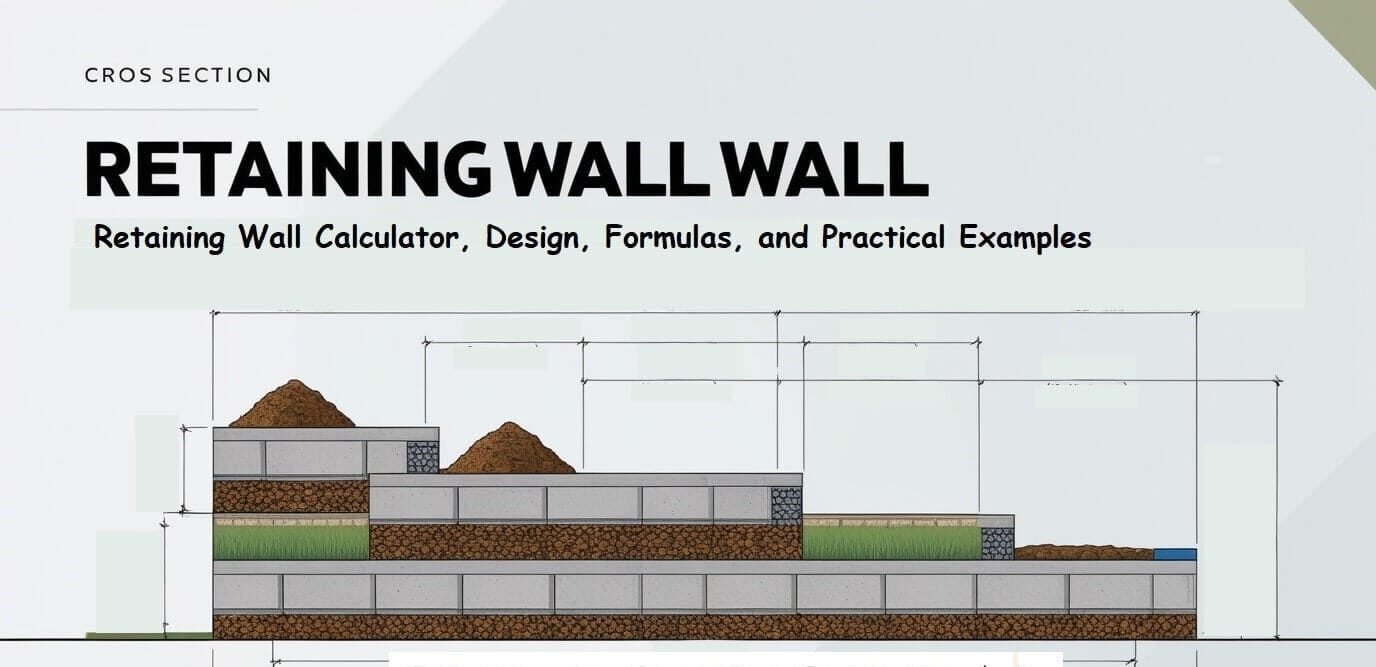
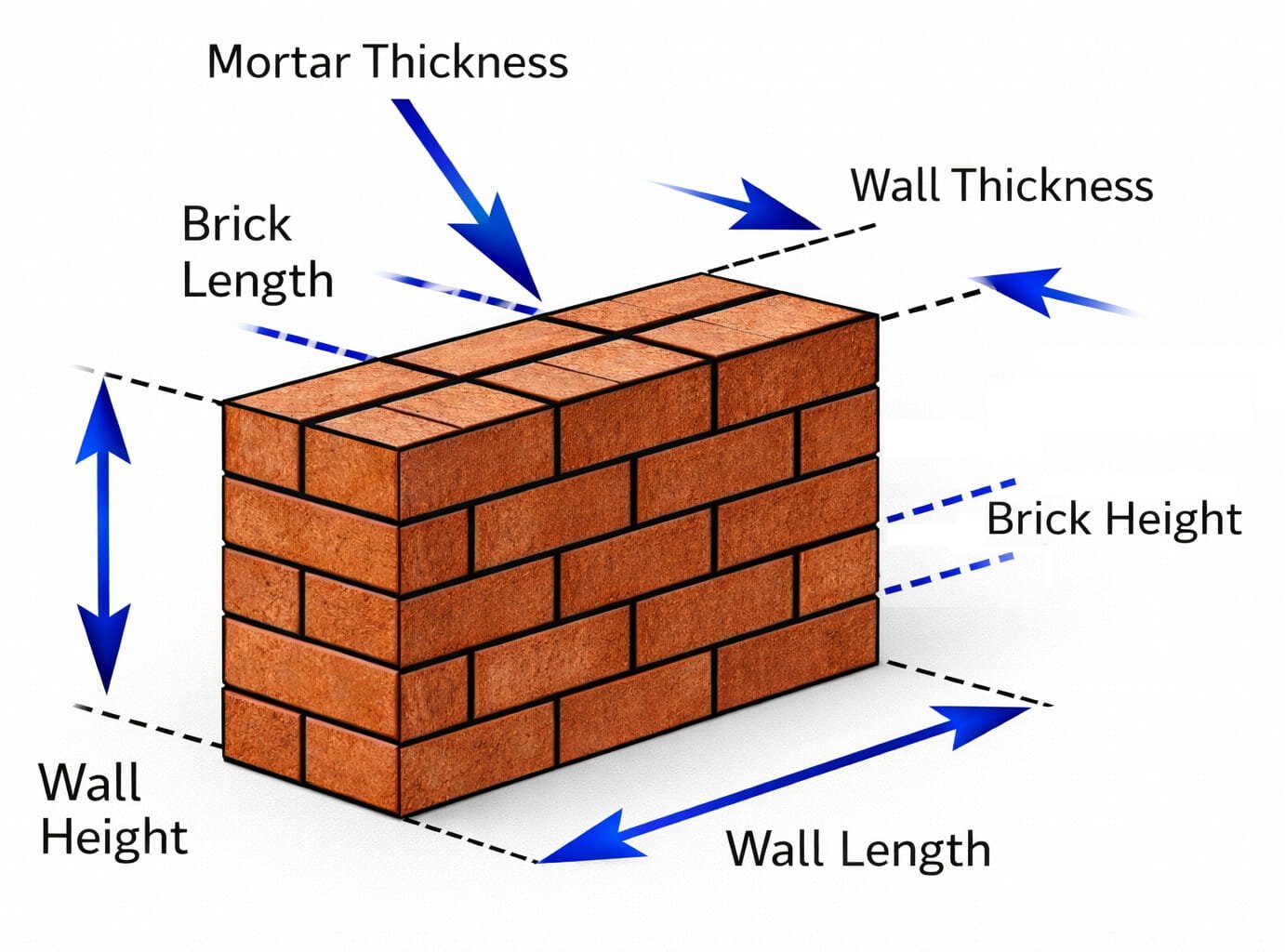
The brick sizes are formatted as Length x Width x Height to follow your example of 7.625” x 3.625” x 2.25 as per the above image:
| Country | Size (Inches) | Size (Millimeters) |
|---|---|---|
| United States | 7.625” x 3.625” x 2.25” | 194 mm x 92 mm x 57 mm |
| United Kingdom | 8.625” x 4.125” x 2.625” | 215 mm x 102.5 mm x 65 mm |
| Australia | 9” x 4.33” x 3” | 230 mm x 110 mm x 76 mm |
| India | 7.5” x 3.5” x 3.5” | 190 mm x 90 mm x 90 mm |
| South Africa | 8.75” x 4.25” x 3” | 222 mm x 106 mm x 73 mm |
| Germany | 9.5” x 4.5” x 2.75” | 240 mm x 115 mm x 71 mm |
| Russia | 10” x 5” x 2.5” | 250 mm x 120 mm x 65 mm |
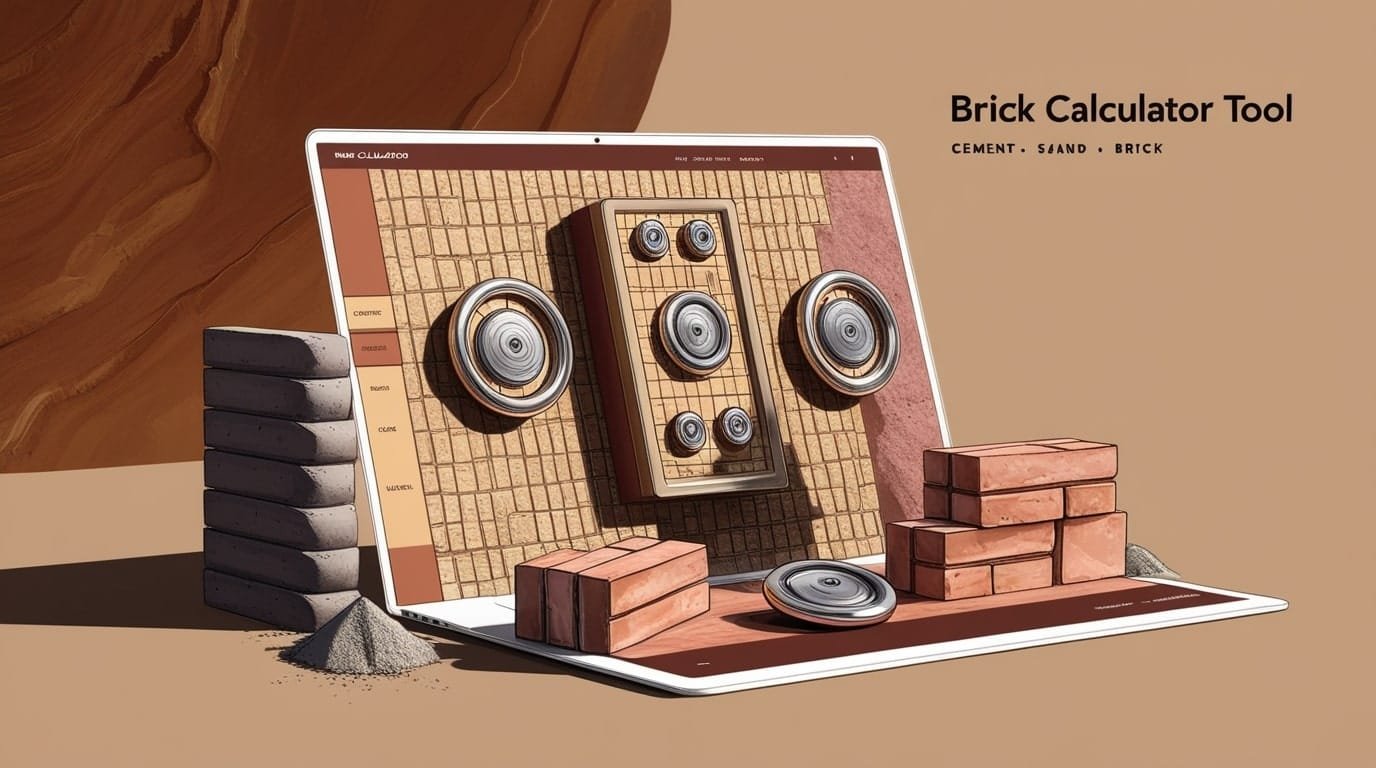
Brick Calculator
Wall ke inputs ke basis par bricks, mortar, cement bags, aur sand estimate hota hai. (Window/Door area subtract hota hai.)
| Description | Value |
|---|---|
| Net Wall Volume | |
| Bricks (Base) | |
| Bricks (With Wastage) | |
| Bricks Cost | |
| Mortar (Wet Volume) | |
| Cement Bags | |
| Sand (Dry Volume) | |
| Cement Cost |
How to Use This Tool
Enter Wall Dimensions:
- Specify the length, height, and thickness of the wall.
- If there are windows or doors, enter the total area to subtract.
Enter Brick Dimensions:
- Input the length, width, and thickness of a brick.
Enter Brick and Cement Prices:
- Provide the price per brick.
- Enter the price per cement bag and the weight of a cement bag in kilograms.
Enter Mortar Ratios:
- Specify the cement to sand ratio for the mortar mixture.
Click "Calculate":
- After entering the values, press the "Calculate" button to see the results.
- The tool will display the total volume, number of bricks, brick cost, cement bags needed, sand volume, and cement cost.
This tool provides a quick and effective way to estimate the number of materials required for building a wall, helping in budgeting and project planning.
Formulas Used (Brick Calculator)
0.94921875.
That factor reduces bricks and is not a valid “wastage” method. Wastage should increase bricks:
\(N_{total} = \lceil N_{base} \times (1 + w/100) \rceil\)
where w is the wastage percentage (typical 3%–10%).1) Wall Volume
First, compute the net wall volume by subtracting openings (windows/doors).
Feet units (ft³ / CFT):
Thickness is converted from inches to feet by dividing by 12.
Metric units (m³):
Thickness is converted from millimeters to meters by dividing by 1000.
2) Brick Volume
Compute the volume of one brick (without mortar).
Feet (brick dimensions in inches → ft³):
Metric (brick dimensions in mm → m³):
3) Number of Bricks (More Accurate Method)
Bricks are best estimated using the brick module volume (brick size + mortar joint thickness), not brick-only volume. This accounts for mortar space.
Brick module volume: (joint thickness = \(J\))
Base bricks (before wastage):
Total bricks (with wastage % \(w\)):
Common joint thickness: 3/8 in (0.375 in) or 10 mm.
Typical wastage: 3%–10%.
4) Brick Cost
5) Mortar, Cement Bags, and Sand
Instead of using fixed constants (like 0.3175 or 0.33), a more consistent method is:
compute mortar from the difference between wall volume and brick volume used.
Wet mortar volume:
Dry mortar volume: (dry factor \(F_{dry}\) commonly ~1.33)
Split by ratio (Cement : Sand = \(C:S\)):
Cement bags: (using cement bulk density \(\rho\approx1440\,kg/m^3\))
Cement cost:
Note: If your calculator internally works in ft³, convert to m³ for the density step:
1 ft³ = 0.0283168466 m³.
Worked Example (Feet)
Inputs used:
- Wall length \(=15\) ft, height \(=10\) ft, thickness \(=6\) in
- Openings area \(=5\) ft²
- Brick size \(=9 \times 4.5 \times 3\) in
- Mortar joint \(J=3/8\) in, wastage \(w=5\%\)
- Mix ratio \(1:5\), dry factor \(F_{dry}=1.33\)
- Bag weight \(W_{bag}=50\) kg, brick price \(=0.50\), bag price \(=6\)
Step 1 — Wall volume:
Step 2 — Brick volume:
Step 3 — Brick module volume (with joint \(J=3/8\) in):
Step 4 — Bricks:
Step 5 — Brick cost:
Step 6 — Mortar, cement, sand, bags:
Convert cement volume to m³ for bag calculation: \(3.3996\;ft^3 \times 0.0283168466 \approx 0.0962\;m^3\)
Step 7 — Cement cost:
Results are estimates. Actual site quantities vary by workmanship, joint thickness, brick type, and waste.
Brick Calculator FAQs
1How do you calculate wall volume for brickwork (feet and meters)?
For brick masonry estimation, compute net wall volume by subtracting window/door openings from the gross wall volume so material takeoff stays realistic. In feet (ft³/CFT) convert thickness from inches to feet, and in metric (m³) convert thickness from millimeters to meters to keep units consistent. Use these formulas: $$V_{wall(ft^3)}=\Big(L_{ft}H_{ft}\frac{T_{in}}{12}\Big)-\Big(A_{open(ft^2)}\frac{T_{in}}{12}\Big)$$ $$V_{wall(m^3)}=\Big(L_{m}H_{m}\frac{T_{mm}}{1000}\Big)-\Big(A_{open(m^2)}\frac{T_{mm}}{1000}\Big)$$
2What is the brick volume formula (inches-to-feet and mm-to-meters)?
Brick volume is length × width × thickness, but accurate unit conversion is critical for a construction calculator and brickwork estimate. For inches, divide each dimension by 12 to convert to feet; for millimeters, divide each dimension by 1000 to convert to meters. Use: $$V_{brick(ft^3)}=\Big(\frac{L_{in}}{12}\Big)\Big(\frac{W_{in}}{12}\Big)\Big(\frac{B_{in}}{12}\Big)$$ $$V_{brick(m^3)}=\Big(\frac{L_{mm}}{1000}\Big)\Big(\frac{W_{mm}}{1000}\Big)\Big(\frac{B_{mm}}{1000}\Big)$$
3Why is “brick module volume” more accurate than brick-only volume?
Brick-only volume ignores mortar joints, so it can distort the number of bricks and the mortar, cement, and sand quantities in masonry planning. The brick module method adds joint thickness to brick dimensions, which matches real bricklaying spacing and reduces estimation bias. Use: $$V_{module}=(L_b+J)(W_b+J)(B_b+J)$$
4How do you calculate the number of bricks for a wall (best practice)?
Divide net wall volume by the brick module volume and round up, because bricks are purchased as whole units and brickwork needs practical rounding. This method is more consistent than using random efficiency numbers and better reflects mortar joints and real masonry layout. Use: $$N_{base}=\left\lceil\frac{V_{wall}}{V_{module}}\right\rceil$$
5How do you apply wastage (breakage) correctly in brick estimation?
Wastage increases the brick quantity to cover breakage, cutting, transport loss, and imperfect units that happen in real construction work. Typical wastage ranges from 3% to 10% depending on site handling, brick quality, corners, openings, and workmanship. Use: $$N_{total}=\left\lceil N_{base}\left(1+\frac{w}{100}\right)\right\rceil$$
6How do you calculate mortar volume for brick masonry?
A consistent mortar estimate is net wall volume minus the solid brick volume used, which approximates wet mortar requirement for bricklaying. This adapts naturally to brick size, joint thickness, and wall thickness, so your material estimation stays scalable across projects. Use: $$V_{mortar,wet}=V_{wall}-\left(N_{base}\times V_{brick}\right)$$
7What is dry mortar factor (1.33) and why is it used?
Mortar is placed wet but ingredients are measured dry, so a dry conversion factor helps estimate cement and sand more realistically for construction planning. A common approximation is \(F_{dry}\approx1.33\), though it can vary with sand moisture, compaction, and site practice. Use: $$V_{mortar,dry}=V_{mortar,wet}\times F_{dry}$$
8How do you split mortar into cement and sand for a given ratio (e.g., 1:5)?
For mortar ratio \(C:S\), split dry mortar volume into cement and sand using fraction rules, which is standard in mix design and quantity surveying. This method is consistent for brick masonry, plaster work, and other cement–sand applications where material takeoff matters. Use: $$V_{cement}=V_{mortar,dry}\times\frac{C}{C+S},\quad V_{sand}=V_{mortar,dry}\times\frac{S}{C+S}$$
9How do you calculate cement bags from cement volume (50 kg or custom bag weight)?
Convert cement volume into weight using bulk density, then divide by bag weight (commonly 50 kg) to get cement bags for purchasing and site logistics. A practical bulk density is \(\rho_{cement}\approx1440\,kg/m^3\), which works well for estimating in most civil engineering cases. Use: $$Bags=\frac{V_{cement}\times \rho_{cement}}{W_{bag}}$$
10How do you calculate bricks cost and cement cost in a budget estimate?
Multiply quantities by unit prices to estimate costs quickly, which helps in construction budgeting, BOQ planning, and brickwork procurement. For realistic totals, use bricks with wastage and cement bag count from the ratio-based mortar method. Use: $$Cost_{bricks}=N_{total}\times Price_{brick}$$ $$Cost_{cement}=Bags\times Price_{bag}$$
11How do window/door openings affect brick quantity and mortar usage?
Openings reduce net wall volume, which reduces bricks, mortar, cement bags, and sand in your construction bill of materials. For best accuracy, combine all openings into a single total opening area and subtract it using the wall volume equation for your unit system. Use: $$V_{open}=A_{open}\times T$$
12What mortar joint thickness should I use (3/8 in vs 10 mm)?
Typical mortar joint thickness is about 3/8 inch (0.375 in) for imperial projects and about 10 mm for metric projects, but actual values depend on workmanship and brick type. Joint thickness changes brick module volume, so it impacts brick quantity and mortar consumption in real brickwork estimation. Use: $$L_{module}=L_b+J,\quad W_{module}=W_b+J,\quad B_{module}=B_b+J$$
13Is the older factor 0.94921875 correct for wastage or efficiency?
No—multiplying brick quantity by 0.94921875 reduces bricks, so it does not represent wastage, breakage, or construction loss in real masonry work. If you want to model efficiency, do it transparently and never replace wastage with a reduction factor, because it underestimates materials. Correct wastage increases quantity: $$N_{total}=\left\lceil N_{base}\left(1+\frac{w}{100}\right)\right\rceil$$
14How do you convert between ft³ and m³ for construction quantity calculations?
Unit conversion matters when you use density formulas (cement kg/m³) alongside wall volumes measured in ft³ for brickwork estimation. A practical conversion is \(1\,ft^3=0.0283168466\,m^3\) and \(1\,m^3\approx35.3146667\,ft^3\), which keeps results consistent. Use: $$V_{m^3}=V_{ft^3}\times0.0283168466,\quad V_{ft^3}=V_{m^3}\times35.3146667$$
15What inputs give the most accurate brick calculator results for real projects?
For accurate results, enter correct wall thickness, total opening area, actual brick size, and a realistic joint thickness used on site by your mason. Choose a reasonable wastage percent and a mortar ratio appropriate for brick masonry (often 1:4, 1:5, or 1:6) for better material takeoff. The overall pipeline is: $$V_{wall}\rightarrow V_{module}\rightarrow N_{base}\rightarrow N_{total}\rightarrow V_{mortar}\rightarrow Bags$$
Resources
- ASTM International - Standard Specification for Building Brick (ASTM C62-10): This page outlines the standard specifications for building bricks, covering both clay and shale-based units. It details manufacturing processes, unit shapes, and dimension tolerances.
- ASTM Specifications for Brick and Mortar: This page provides a comprehensive review of the ASTM specifications related to brick and mortar, focusing on properties that affect brick durability and water resistance.
- British Standards Institution (BSI) - Brick and Block Masonry Standards: BSI sets the standards for brick and block masonry, ensuring that measurements, brick sizes, and construction materials adhere to UK regulations.
- ASTM C216 - Standard Specification for Facing Brick: This specification focuses on the requirements for facing bricks used in structural and non-structural applications, with guidelines on durability, size, and appearance.
- ISO Standards for Bricks and Masonry: The International Organization for Standardization (ISO) provides guidelines for the manufacture and use of bricks globally, ensuring consistent quality across different regions.