Steel Weight Calculator

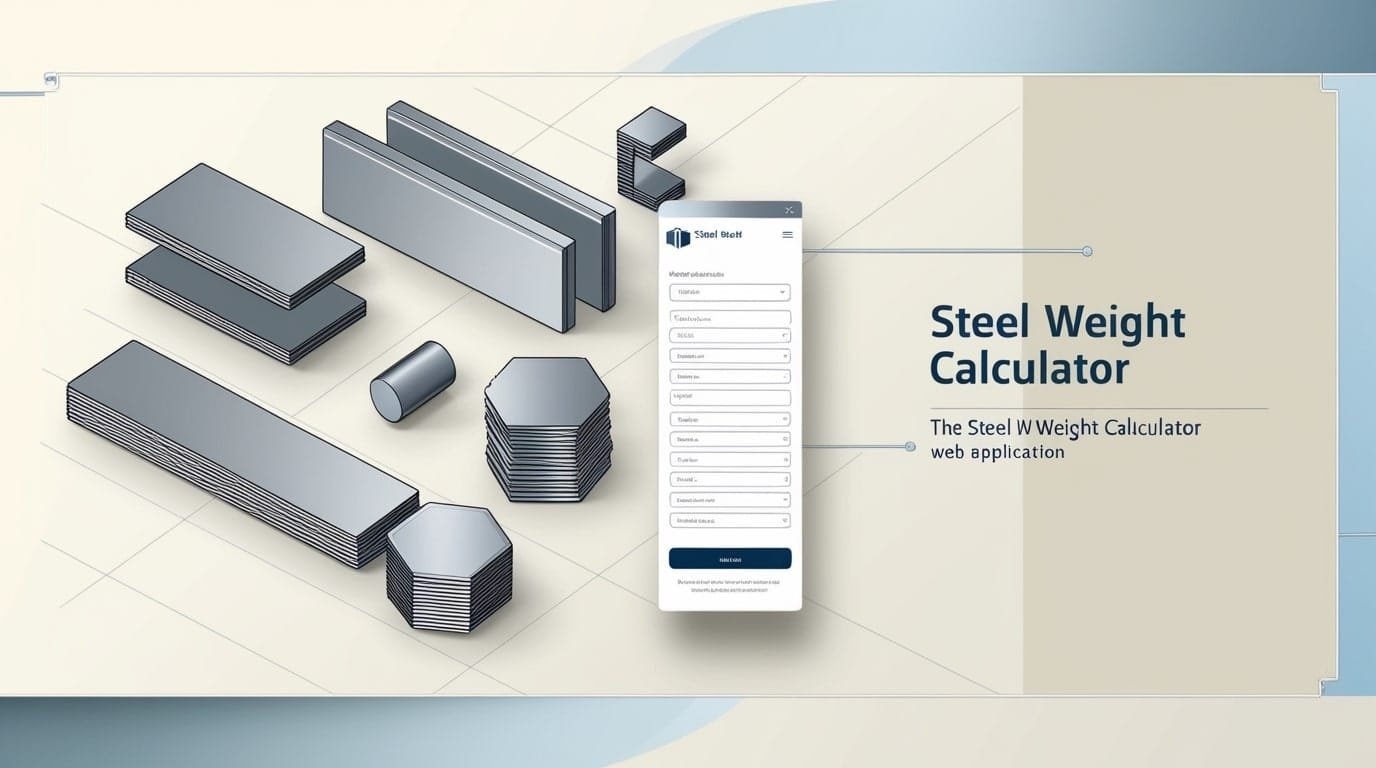
The Steel Weight Calculator is a powerful and user-friendly web tool designed to simplify the process of calculating the weight of various steel and metal bars. It allows users to input specific dimensions and material types to calculate the weight, both in kilograms (kg) and pounds (lb). This tool is particularly useful for engineers, architects, and metal fabricators who need to quickly estimate the weight of materials for structural designs, manufacturing, or construction projects.
How to Use the Steel Weight Calculator
I) Material Selection:
Start by selecting the type of material from the dropdown menu. The calculator supports common materials such as:
| Material Type | Density (kg/m³) | Density (kg/ft³) | Yield Strength (MPa) | Tensile Strength (MPa) | Typical Applications |
|---|---|---|---|---|---|
| Mild Steel | 7850 | 222.41 | 250-400 | 400-550 | Structural beams, reinforcement bars (rebar), pipelines |
| Cast Iron | 7200 | 203.91 | 100-400 | 200-800 | Pipes, foundations, machinery parts |
| Aluminum | 2700 | 76.46 | 70-250 | 150-350 | Lightweight structures, window frames, cladding |
| Acetal (Plastic) | 1430 | 40.51 | 60-80 | 70-100 | Gears, bearings, fasteners in precision equipment |
II) Shape Selection:
Choose the shape of the metal bar from the available options:
- Round Bar: A cylindrical shape
- Square Bar: A bar with equal width and depth.
- Rectangular Bar: A bar with different width and depth dimensions.
- Hex Bar: A bar with six equal sides.
Each shape has a unique formula for calculating weight , which, when multiplied by the density, gives the weight.
III) Input Dimensions
You can choose from different units for each dimension, including millimeters (mm), centimeters (cm), meters (m), inches (in), and feet (ft).
IV) Calculation Results
The results are instantly displayed as soon as the dimensions are input:
Weight in Kilograms (kg): The calculated weight based on the input values and selected material.
Weight in Pounds (lb): The weight is also converted into pounds for ease of reference.
Steel Weight Calculation Formulas & Worked Examples
This reference section documents the exact formulas used by the calculator for round, square, rectangular, and hex bars. Every input is first converted into millimeters (mm), then volume is computed in mm³, converted into m³, and finally multiplied by the selected material density to produce weight in kilograms and pounds.
Global Volume & Weight Formulas
- \(V_{\text{mm}^3}\): volume computed from the selected shape in cubic millimeters.
- \(V_{\text{m}^3}\): same volume converted to cubic meters (required for kg/m³ density).
- \(\rho\): density of the chosen material in kg/m³.
Round Bar (Diameter = \(D\))
A round bar is modeled as a perfect cylinder. The calculator interprets the input as the full diameter \(D\) (not the radius), converts it to millimeters, and computes the circular cross-sectional area. The volume is then the area multiplied by the bar length. This approach is standard for cylindrical stock and matches how round bar sizes are specified in workshops and catalogs.
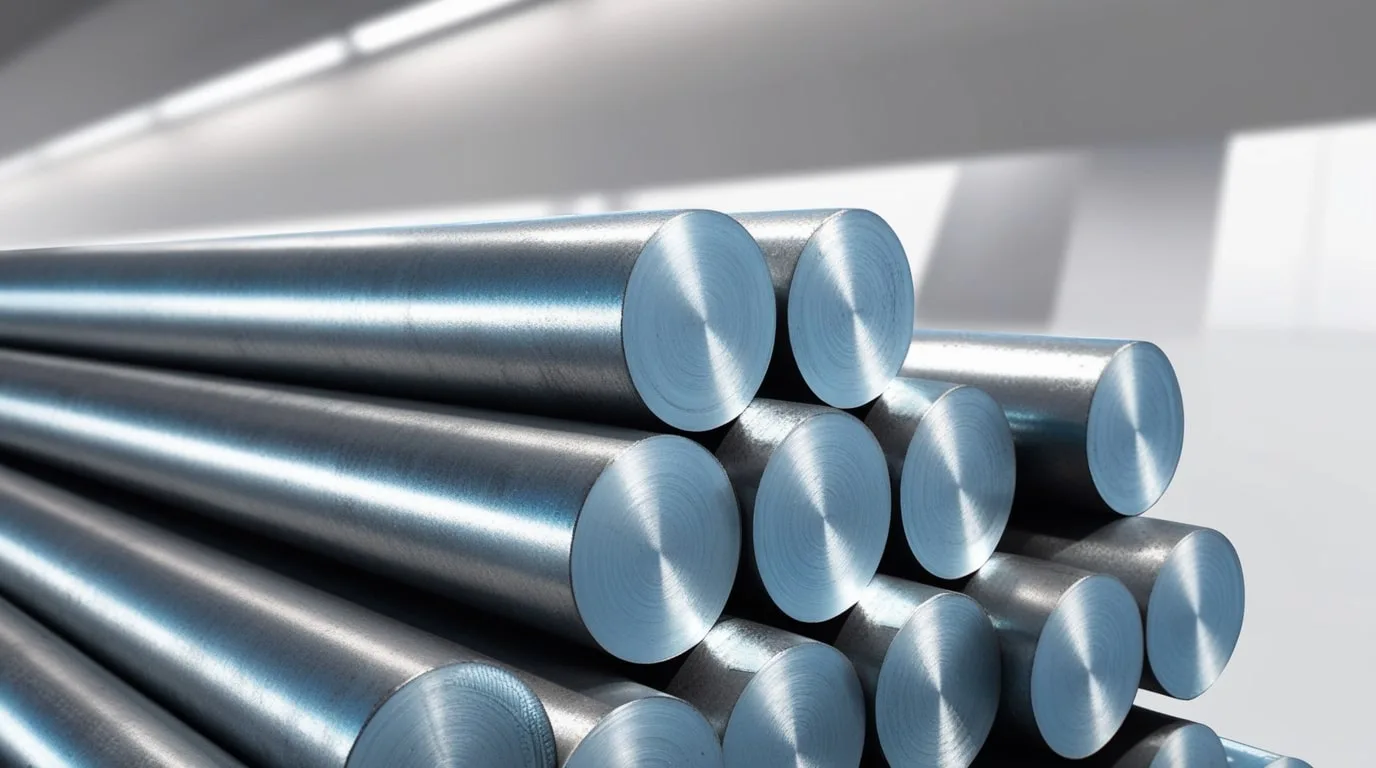
Worked example (Mild Steel): \(D=20\text{ mm},\; L=1\text{ m},\; \rho=7850\text{ kg/m}^3\)
Square Bar (Width = \(W\))
A square bar has a constant square cross-section along its entire length. The calculator treats the single width input \(W\) as the side length of the square, converts it to millimeters, and squares it to get cross-sectional area. The total volume is obtained by multiplying that area by the converted length \(L_{\text{mm}}\). This is the standard method used for square steel stock.

Worked example (Mild Steel): \(W=25\text{ mm},\; L=2\text{ m},\; \rho=7850\text{ kg/m}^3\)
Rectangular Bar (Width = \(W\), Depth = \(T\))
A rectangular bar has two independent dimensions: width \(W\) and thickness/depth \(T\). The calculator converts both measurements to millimeters and multiplies them to obtain the rectangular cross-sectional area. The volume is that area multiplied by the bar length. This method is used for flat bars, rectangular stock, and similar profiles where both width and thickness define the section.
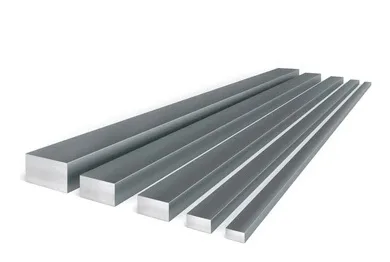
Worked example (Mild Steel): \(W=50\text{ mm},\; T=10\text{ mm},\; L=3\text{ m},\; \rho=7850\text{ kg/m}^3\)
Hex Bar (Across Flats = \(AF\))
A hex bar is a regular hexagon in cross-section. The calculator expects the measurement “across flats” (\(AF\)), which is the distance between two opposite parallel faces. For a regular hexagon, the area in terms of across-flats is \(A=\frac{\sqrt{3}}{2}AF^2\). After computing area in mm², the calculator multiplies by length \(L_{\text{mm}}\) to obtain volume in mm³.
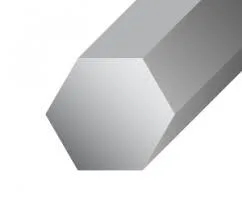
Worked example (Mild Steel): \(AF=30\text{ mm},\; L=1.5\text{ m},\; \rho=7850\text{ kg/m}^3\)
Steel Bars Shape and Their Uses
Steel bars come in various shapes and sizes, each suited for different applications:
- Round Bars: Commonly used in construction and manufacturing for axles, bolts, and other machine parts.
- Square Bars: Used in structural applications, fabrication, and general manufacturing.
- Rectangular Bars: Ideal for metal framing, structural applications, and precision machining.
- Hex Bars: Commonly used for fasteners and other components that require hexagonal profiles for tool access.
FAQ
1. How do I calculate the weight of steel?
To calculate the weight of steel, you need to know its volume and density. The formula is:
Weight = Volume × Density.
For example, for a rectangular bar, the volume is calculated as Width × Depth × Length, and the density of mild steel is approximately 7850 kg/m³. Convert all dimensions to meters for accurate results.
2. What is the density of common metals used in weight calculations?
The density of common metals is as follows:
- Mild Steel: 7850 kg/m³
- Cast Iron: 7200 kg/m³
- Aluminium: 2700 kg/m³
- Acetal: 1430 kg/m³
These values are essential for accurate weight calculations.
3. How do I convert steel weight from kilograms to pounds?
To convert steel weight from kilograms to pounds, use the conversion factor 1 kg = 2.20462 lbs. Multiply the weight in kilograms by 2.20462 to get the weight in pounds. For example, 10 kg of steel is approximately 22.0462 lbs.
4. What is the formula for calculating the weight of a round bar?
The formula for calculating the weight of a round bar is:
Weight = (π × (Diameter/2)² × Length × Density).
Ensure all measurements are in the same unit (e.g., meters) for accurate results. For example, a round bar with a diameter of 10 mm and length of 1 meter would have a volume of π × (0.005)² × 1 = 0.0000785 m³.
5. How do I calculate the weight of a rectangular bar?
The formula for calculating the weight of a rectangular bar is:
Weight = Width × Depth × Length × Density.
For example, a rectangular bar with dimensions 10 mm (width) × 5 mm (depth) × 1 meter (length) would have a volume of 0.01 × 0.005 × 1 = 0.00005 m³. Multiply this by the density of the material to get the weight.
6. What units should I use for steel weight calculations?
For steel weight calculations, it is recommended to use consistent units. Common units include:
- Millimeters (mm) for small dimensions.
- Meters (m) for larger dimensions.
- Kilograms (kg) or Pounds (lbs) for weight.
Always convert all measurements to the same unit before performing calculations.
7. How does the shape of the metal affect its weight calculation?
The shape of the metal determines the formula used to calculate its volume. For example:
- Round Bar: Volume = π × (Radius)² × Length
- Square Bar: Volume = Side² × Length
- Rectangular Bar: Volume = Width × Depth × Length
- Hex Bar: Volume = (1.732 × Width² × Length) / 2
Once the volume is calculated, multiply it by the material’s density to get the weight.
8. What is the difference between mild steel and cast iron in weight calculations?
The primary difference lies in their densities:
- Mild Steel: 7850 kg/m³
- Cast Iron: 7200 kg/m³
This means that for the same volume, mild steel will weigh more than cast iron. Always use the correct density value for accurate calculations.
9. Can I use this calculator for non-metallic materials like acetal?
Yes, the calculator can be used for non-metallic materials like acetal, provided you input the correct density value. For acetal, the density is 1430 kg/m³. The same formulas apply, but the density value changes based on the material.
10. How accurate is an online steel weight calculator?
An online steel weight calculator is highly accurate if the input values (dimensions and material density) are correct. However, always double-check calculations for critical applications, as small errors in input can lead to significant discrepancies in results.